


Germany's private pension system just got its biggest overhaul in two decades. The Riester-Rente - that familiar but widely criticised pension scheme - is being replaced. The Altersvorsorgereformgesetz (Private Pension Reform Act) passed the Bundestag on 27 March 2026 and was signed into law on 8 May 2026. Starting 1 January 2027, no Riester contracts to old conditions can be signed but only the new system can be taken out.
The new system is called the Altersvorsorgedepot. If you have been putting off private pension planning in Germany because Riester was too expensive, too complicated, or just never felt like the right fit, the new system is actually different.
Here is what changed and what it means for you.
What is the Altersvorsorgedepot?
The Altersvorsorgedepot (retirement savings accountdepot) is the new state-subsidised private pension product that replaces Riester from 2027. The fundamental shift: instead of paying into a traditional insurance-style pension plan, you can invest directly in ETFs and funds.
Here is how it works. You open a depot with a certified provider - banks, insurers, fund companies, or neobrokers. You set up a savings plan to invest in eligible products of your choice. During the savings phase, your capital gains are not taxed. You pay tax only when you start withdrawing in retirement, at your personal income tax rate. To qualify for the state subsidy, you need to contribute at least €120 per year (€10 per month).
What can you invest in?
The product covers funds with a risk rating (SRRI) of 1 to 5 out of 7 (the Altersvorsorgedepot permits a broad range including standard equity ETFs, but excludes the two highest-risk tiers). It includes a wide range of standard equity and bond ETFs. EU and German government bonds are also eligible.
What is not allowed: individual company shares, crypto assets, and other complex or speculative instruments.
If picking your own ETFs sounds like more than you want to deal with, there is an option called the Standarddepot Altersvorsorge: a pre-configured version with legally defined investment defaults and a hard cost cap of 1% effective annual costs. No provider can charge more than this. The government is also planning a publicly managed version to keep private providers' fees competitive.
What about the guarantee?
This is one of the biggest differences from Riester. Old Riester contracts required a 100% capital guarantee, meaning every euro paid in had to be returned at retirement, no matter how the markets performed. That guarantee forced insurers into conservative, low-return strategies for the entire savings period.
With the Altersvorsorgedepot, you choose your guarantee level: 100% capital protection, 80%, or no guarantee at all. The no-guarantee option lets you invest fully in equity ETFs. Over a long horizon, equity markets have historically produced significantly higher returns than bond-heavy guaranteed products.
For younger savers with 20 or 30 years ahead of them, this is a meaningful change.
How do you get the money out?
Payouts can begin at age 65 at the earliest and must start by age 70 at the latest. You have three options:
The 30% lump-sum option is a notable flexibility feature. It can cover larger one-time expenses at the start of retirement (paying off a mortgage, moving costs, travel) while still maintaining a steady income stream from the rest.
How much does the state contribute?
The subsidy structure has been redesigned from scratch and is considerably more generous than what Riester offered.
Under Riester, the flat annual adult allowance was €175. Under the Altersvorsorgedepot, it is structured like this:
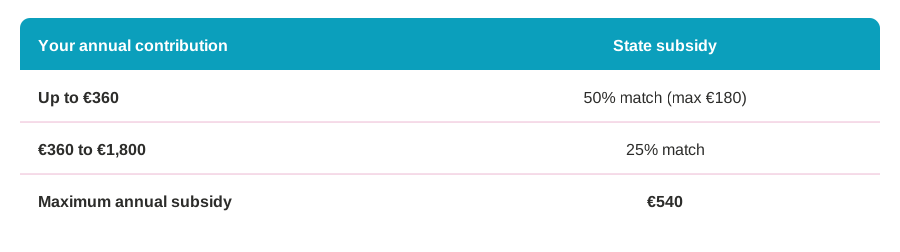
Contributing the full €1,800 per year (€150 per month) means the state adds €540. That is three times what Riester ever offered per adult.
For families
Parents receive a separate child allowance of up to €300 per year per child, on top of the basic adult subsidy. This works as a 1:1 match: for every euro you contribute toward your child's allowance, the state adds one euro, up to the €300 cap. Contributing €25 per month gets you the full match. A family with two children could receive up to €1,140 in state subsidies annually (€540 basic plus €300 per child), but the child portion requires your own contributions to unlock. As with Riester, the child allowance requires that Kindergeld is being received for that child.
The under-25 bonus
If you are under 25 and opening your first Altersvorsorgedepot, you receive a one-time Berufseinsteiger-Bonus of €200 on top of the regular subsidy. For young expats just starting their career in Germany, this is an easy win - it lands in your depot in year one and starts compounding immediately.
The Frühstart-Rente
Alongside the pension reform, the government plans to introduce a separate programme called the Frühstart-Rente for children. This requires its own legislation, which has not yet been passed, but the intention has been confirmed. The plan: starting from 2027, the state would invest €10 per month (€120 per year) directly into an Altersvorsorgedepot for every child aged 6 to 17. Parents would not need to contribute anything for this - it would be a pure state grant, backdated so that 2026 counts even though payments would only begin in 2027.Compound interest over several decades means even €120 per year can build into a meaningful sum by retirement age. Parents could add their own contributions on top and claim the child allowance separately. We will update this section once the Frühstart-Rente legislation is officially passed.
The tax side
Beyond the direct subsidies, the Altersvorsorgedepot follows the EET principle: contributions may be deducted on your German tax return as Sonderausgaben (special expenses), returns in the savings phase are completely tax-free, and you only pay tax on withdrawals in retirement. If your marginal tax rate is 35% or higher, the tax savings alone can be worth more than the direct subsidy.
Who can use it?
Under Riester, eligibility was tied to mandatory German pension contributions, which excluded the self-employed entirely and created complications for many expats. The Altersvorsorgedepot has expanded the list considerably.
The following groups are eligible for the subsidy:
For expats specifically
German citizenship is not required. What matters is whether you are subject to German income tax (unbeschrankt steuerpflichtig or fiktiv unbeschrankt steuerpflichtig) and whether you are paying into a statutory pension system - Germany's or your home country's. If you work in Germany under a German employment contract, you almost certainly qualify.
If you live outside Germany but remain subject to German income tax - for example, because you continue to work for a German employer - you may also be eligible. This is worth checking individually, particularly for people who split time between Germany and another country.
The partner rule
Non-working spouses or partners who do not qualify on their own can still receive subsidies through the partner rule (mittelbare Forderung). Your working partner must qualify and hold an Altersvorsorgedepot; you then open your own depot and contribute a minimum of €60 per year to access the full subsidy indirectly.

Who does not qualify?
Mini-jobbers who have opted out of statutory pension contributions are not eligible for the subsidy. Non-working spouses or partners without the partner rule setup also do not qualify on their own.
Not everyone benefits equally from the switch. Whether the new Altersvorsorgedepot gives you more or less state support than Riester depends on your income and family situation.
Here are four real examples:
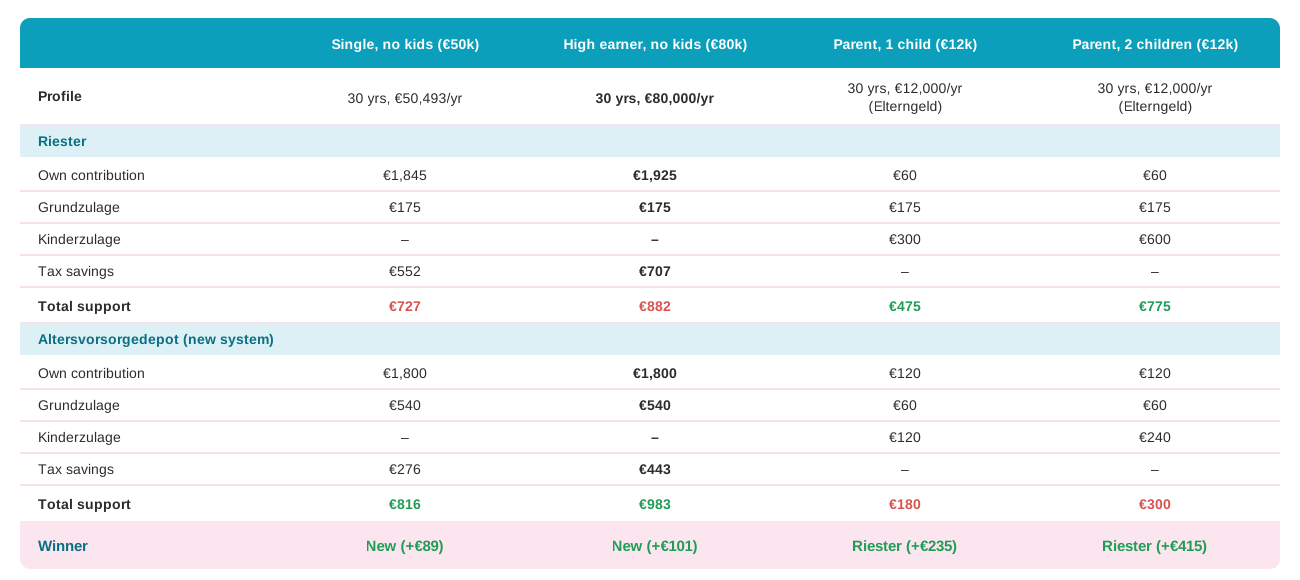
As the numbers show, singles and higher earners come out slightly ahead under the new system. But for low-income families with children, the picture is different: they receive less state support than under Riester.
Where the new system really delivers is not in the subsidies, but in how it works: you can invest in ETFs instead of guaranteed products, costs are capped at 1%, self-employed people finally have access, and you are no longer forced into a lifelong annuity. For most people, those structural changes matter more than the difference in subsidies.
What happens to your existing Riester contract?
If you already have a Riester contract, the key message is: you do not need to do anything immediately.
Existing contracts receive full Bestandsschutz (grandfathering). Your contract continues exactly as before. You can keep contributing to it, and all previously earned subsidies and tax advantages remain intact. There is no forced switch, no automatic cancellation.
Can you transfer to the new system?
Yes. From 2027, you can voluntarily transfer your Riester balance to an Altersvorsorgedepot. After five years with your current Riester provider, the transfer is free of charge and does not require your provider's consent. If you have been with your provider for less than five years, the maximum switching fee is capped at €150. All previously received subsidies and tax benefits are preserved through the transfer regardless.
The case for switching can be strong. The Altersvorsorgedepot caps fees at 1% effective annual costs, versus the 1.5-2% average on many existing Riester contracts. The basic subsidy is three times higher. And there is no return-suppressing guarantee if you do not want one.

But do not rush!
Whether switching makes sense depends on your specific contract. Some Riester products, particularly older Riester-Rentenversicherungen, have built-in guaranteed annuity rates, bonus credits, or surplus participation that might not survive a transfer. People closer to retirement face a different calculation than someone with 25 years left to save. And no Altersvorsorgedepot products exist yet - providers have until 1 January 2027 to launch certified offerings.
The sensible approach for most people: keep your existing contract running for now, see what products come to market in 2027, and get an individual assessment before deciding whether to transfer.

Frequently asked questions
Yes. There is no rule against holding both. The subsidy caps apply per person across all products together, so you cannot receive more than one set of adult allowances, but running both simultaneously while you assess your options is perfectly possible.
It depends on your plans. Subsidies are linked to German income tax residency. If you leave Germany and stop being subject to German income tax, you may need to repay the subsidies received - as was also the case with Riester.
But it is only for fute subsidies no? I do not think you have to pay back anything, if you simply stop paying into it.
However, the investment growth you have built up during your German years remains yours. For expats planning to stay 10 years or more, the Altersvorsorgedepot can still be a good deal even factoring in a potential departure. For those with shorter horizons, it is worth running the numbers with an adviser first.
Both products are now available to self-employed people, but they work differently. The Rurup-Rente (Basisrente) allows deductions of up to approximately €30,000 per year (€30,826 in 2026, adjusted annually), making it more tax-efficient for high earners, but payouts are fully taxed in retirement and you cannot access your capital before retirement age.
The Altersvorsorgedepot offers a direct subsidy of up to €540, lower tax deductions, and a more flexible drawdown structure in retirement - including the 30% lump-sum option at payout start. For self-employed people with a high and stable income, the Rurup deduction tends to be more valuable. For those with lower or variable income, the Altersvorsorgedepot is often the better fit. In some cases, combining both makes sense.
The guarantee on old Riester contracts felt reassuring, but it came at a real cost: conservative allocations that significantly underperformed equity markets over the long run. With the Altersvorsorgedepot, risk management is more in your hands.
A few practical principles:
First, broad ETFs (like a global index fund) already spread risk across thousands of companies.
Second, time is your biggest safety net - over a 20 or 30-year horizon, equity ETFs have historically recovered from downturns and produced strong returns.
Third, you can adjust as you go: start with the no-guarantee option while you are young, then gradually shift toward the 80% or 100% guarantee as you approach retirement.
If you are within 10 years of retirement and cannot afford significant volatility, a partial or full guarantee still makes sense from day one.
No Altersvorsorgedepot products exist yet. Providers have until 1 January 2027 to launch certified offerings. The first products are expected to appear in late 2026. If you want to be ready, the practical step for now is to understand your eligibility and review any existing Riester contract you have.
No action is needed for the state contributions to start. The government plans to automatically open a depot and credit €10 per month for every eligible child. You could choose to add your own contributions on top and claim the €300 per year child allowance separately. Keep in mind that the Fruhstart-Rente still requires its own legislation to be passed. The practical details around how to manage these accounts will become clearer once the programme officially launches.
Need help deciding?
From Riester phase-out to Altersvorsorgedepot launch, self-employed eligibility to Rurup comparisons - there are a lot of moving parts right now. The right move for your situation depends on how long you plan to stay in Germany, whether you are employed or self-employed, what existing contracts you have, your income level, and how much market risk you are comfortable with.
Whether you want to review an existing Riester contract, think through the Altersvorsorgedepot from scratch, or just understand how private pension planning fits into your overall financial picture in Germany, we are happy to help.
Drop us a message - we would love to help you figure it out.

Max Dannewitz

Email: maximilian.dannewitz@versicherungsbuero-weiss.com
Telefon: +49 30 - 40 36 31 95 8
Book a free consultation: https://calendly.com/maximilian-dannewitz-versicherungsbuero-weiss/30min
