
As a GmbH managing director (Geschäftsführer), your situation looks nothing like a regular employee's when it comes to disability insurance. You're the engine of your company, and if that engine stops, there's usually no backup generator waiting in the wings.
This guide compares the three main ways to structure your Berufsunfähigkeitsversicherung (Disability insurance), puts real numbers on the tax differences, and flags the pitfalls you'll want to avoid.
New to Disability insurance in general? Start with our complete guide here first - this article focuses specifically on the GmbH managing director angle.
Why is disability insurance different for you?
Two things set your situation apart from regular employees:
No state safety net:
If you're a controlling shareholder (beherrschender Gesellschafter-Geschäftsführer, typically holding 50% or more), you're usually exempt from mandatory social insurance contributions. That sounds nice until you realize it also means: no Erwerbsminderungsrente. If you become unable to work, the state pays you nothing.
Even minority shareholders who do contribute to the system would only receive a fraction of their income. The average EM-Rente for new recipients sits at roughly €1,150 per month. For someone on a managing director's salary, that's not going to cover much.
Double exposure:
Your personal income and your company's success both depend on your ability to work. If you're out long-term, you lose your salary AND your business may struggle without its key person.
Two problems at once, not just one.
The bottom line: BU insurance isn't optional for you. The real question is how to structure it.

Which model should you choose?
There are three ways to set up disablilty insurance as a GmbH managing director. Each has a different tax treatment during the premium-paying phase and, more importantly, during the payout phase when you actually need the money.
Let's take the same person, same €3,000/month gross BU-Rente, and run it through all three models.
Assumptions: Age 47 at disability, policy runs to age 67 (20 years remaining). Ertragsanteil: 21% (per §55 EStDV). No other significant income during disability. All figures are approximations for illustration - your actual numbers depend on your personal tax situation.
You pay the premiums from your already-taxed salary. They're essentially not tax-deductible - the annual cap for "sonstige Vorsorgeaufwendungen" (§10 EStG) is usually eaten up by health insurance contributions.
The upside comes when you actually need the insurance. Only the Ertragsanteil - a small fraction based on how long the payments will last - counts as taxable income. For most managing directors, this works out to 18-26% depending on your age when disability occurs and how long the policy runs. Since that amount often falls below the tax-free allowance (Grundfreibetrag: €12,348 in 2026), you may end up paying zero tax on your BU payout.
No social insurance contributions either. What you see is what you get.
For our example:
The GmbH pays your disability insurance premiums and deducts them as a business expense. During the premium phase, this saves the company roughly 30% in corporate taxes (Körperschaftsteuer + Gewerbesteuer).
The catch: if you ever collect, the payout is treated as regular employment income. That means full income tax. And if you're in the GKV (public health insurance), you also pay the full health and long-term care insurance contributions on it - both the employer and employee share, since there's no employer splitting the bill anymore. Together, these deductions can eat up 35-40% of your gross disability insurance payout.
If you're privately insured (PKV), the picture improves quite a bit - your premiums are fixed regardless of income, so only income tax applies. But that's still significantly more than the private BU route.
For our example:
Note: if you're PKV-insured, no income-based KV/PV applies. Net improves to roughly €2,540/month.
A disability insurance policy combined with a Rürup pension (Basisrente). Your contributions are 100% tax-deductible since 2023, up to €30,826/year for singles (2026). One restriction: the BU portion can't exceed 49% of the total premium, so you're always pairing it with a pension savings component.
On the payout side: 84% of your BU-Rente is taxable if disability occurs in 2026. This percentage is locked in at the year disability begins and rises gradually to 100% by 2058. No social contributions for PKV members. GKV members who are "freiwillig versichert" may face contributions depending on their individual situation.
For our example:
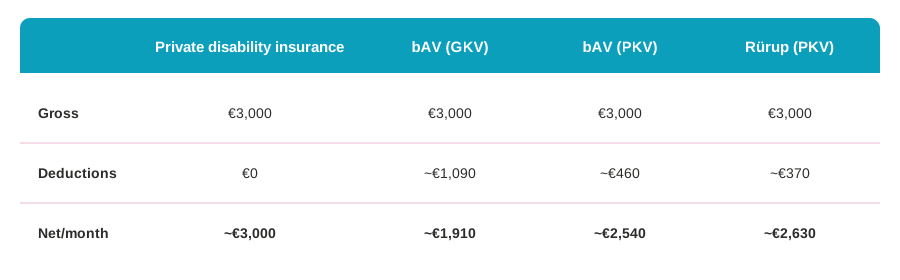
The key trade-off
Save taxes now (bAV or Rürup) vs. keep more when it actually matters (private disability insurance)?
The answer depends on your tax bracket during the contribution phase vs. the payout phase. But there's a useful rule of thumb from actuarial practice: if you go the bAV or Rürup route, insure about 20% more than you would with a private BU. That roughly compensates for the heavier taxation on the payout side.

The Krankentagegeld-to-Disability insurance gap
If you get sick, the chain typically goes: your GmbH continues your salary (Lohnfortzahlung, if your contract includes it), then Krankentagegeld kicks in, and eventually your BU insurance takes over.
The problem: there can be a gap between when your Krankentagegeld ends and when your BU starts paying. This depends on your Karenzzeit (waiting period). If your BU has a 6-month Karenzzeit, make sure your Krankentagegeld coverage runs at least that long.
Important for controlling shareholders: unlike employees, you typically don't have Krankentagegeld automatically. If you're privately insured, you need to arrange it as a separate add-on to your PKV policy. Many managing directors assume they have it and discover the gap too late.
Equally important: get the Lohnfortzahlung explicitly written into your Geschäftsführer-Anstellungsvertrag. Unlike regular employees, you don't have an automatic legal right to continued salary. Without it in writing, you could end up with no income from day one of an illness.

Frequently asked questions
This distinction matters more than most people realize. A controlling shareholder (beherrschender Gesellschafter, typically 50%+) is usually exempt from social insurance, which means zero EM-Rente entitlement. A minority shareholder may still be in the system and have at least some baseline coverage.
The classification also affects how your bAV can be structured and what triggers vGA concerns. If you're unsure about your status, the Deutsche Rentenversicherung offers a Statusfeststellungsverfahren (status determination procedure) to clarify where you stand.
For anyone who may not stay in Germany permanently, portability is worth weighing heavily.
Yes, through a betriebliche Altersversorgung (bAV) arrangement. The GmbH deducts the premiums as a business expense. But the payout will be fully taxed as income, and you need to structure it carefully to avoid a verdeckte Gewinnausschüttung classification by the tax office.

The bottom line
For most GmbH managing directors, the private disability insurance delivers the highest net payout when you actually need it - and that's the moment that counts. The bAV and Rürup models save taxes during the premium phase, but those savings are more than offset by heavier taxation on the payout side. If you do choose bAV or Rürup, insure about 20% more to close the gap.
Whichever model you pick, the critical piece is coordinating your entire income protection chain - Lohnfortzahlung, Krankentagegeld, and BU-Rente - with no gaps in between.
Need help figuring out which model fits your situation? That's exactly what we do. Reach out to us, and we'll walk through the numbers for your specific case.